Termite Inspection in Kirwan & Mundingburra: What Every Townsville Homeowner Must Know in 2026
In 2024, Queensland Health recorded 2,477 Ross River virus cases. That's more than triple the 2023 total and the highest count since 2020, and Townsville is named explicitly in the research as one of the coastal cities where higher temperatures correlate directly with higher infection rates. So let's be clear about what we're dealing with: mosquitoes in North Queensland aren't a nuisance pest. For residents of Garbutt, Aitkenvale, Rosslea and anywhere near Ross River, Bohle River or the coastal mangrove edges, they're a genuine public health risk.
This article covers the species active in Townsville, the diseases they carry, what professional mosquito control in Townsville actually involves, and the free prevention steps that work, alongside the ones that don't.
The Three Mosquito-Borne Diseases Townsville Residents Face
Ross River virus. Australia's most prevalent mosquito-borne disease, first isolated from mosquitoes trapped beside Ross River in 1959, which is not the kind of local landmark fame anyone wanted. Around 3,000 cases are reported nationally each year, with North Queensland recording cases year-round and peaking between February and May. Symptoms include joint pain and swelling, fever, fatigue and a raised red rash. Most people recover within weeks; the joint pain can hang around for months, occasionally years.
The key vectors here: Culex annulirostris (freshwater breeder), Aedes vigilax (saltmarsh and mangrove breeder), and Aedes notoscriptus, which breeds happily in whatever container your backyard provides.
Barmah Forest virus. Similar presentation: joint pain, rash, fatigue. Less common but present in North Queensland, particularly near wetlands and floodplains. No specific treatment exists.
Dengue fever. Townsville City Council specifically warns that Aedes aegypti, the dengue vector, is established in North Queensland. Unlike Ross River virus, dengue spreads person to person via mosquito bite, no wildlife host required. Aedes aegypti breeds exclusively in artificial containers (pot plant saucers, buckets, clogged gutters, bird baths, tyres) and bites during the day, not at dusk. A dengue outbreak in Townsville is a genuine risk, not a theoretical one.
One more local reality check: Townsville doesn't have a 'mosquito season'. Year-round warmth keeps Aedes and Culex species active every month. Activity peaks during and after the wet season (November to April), but late dry-season outbreaks happen too, particularly when king tides flood the saltmarsh.
Free Prevention: What Actually Works
Townsville City Council runs a city-wide mosquito management program, but at the property level, the most effective prevention is ruthlessly eliminating breeding sites. All it takes is a bottle cap of stagnant water for Aedes aegypti to lay eggs.
The weekly backyard check, every 7 days:
• Empty and scrub everything holding water: pot plant saucers, pet bowls, bird baths, buckets, vases
• Clear the gutters; one blocked gutter holds enough water for tens of thousands of larvae
• Turn over or store unused containers, tyres and equipment that catch rain
• Check your rainwater tank has a tight lid and intact mosquito-proof inlet screens
• Treat ornamental ponds with Bti, a biological larvicide from any hardware store that's toxic only to mosquito larvae
Personal protection:
• Use repellents containing DEET, picaridin or oil of lemon eucalyptus, the active ingredients Queensland Health actually recommends
• Wear loose, light-coloured long sleeves at peak biting times: dawn and dusk for most species, all day for Aedes aegypti
• Keep flyscreens intact and gap-free, especially in Garbutt, Aitkenvale and Rosslea near low-lying ground
What Professional Mosquito Treatment Covers
When the backyard audit isn't enough, particularly after flooding, beside drains or creek lines, or ahead of an outdoor event, professional mosquito pest control delivers a meaningful, measurable reduction.
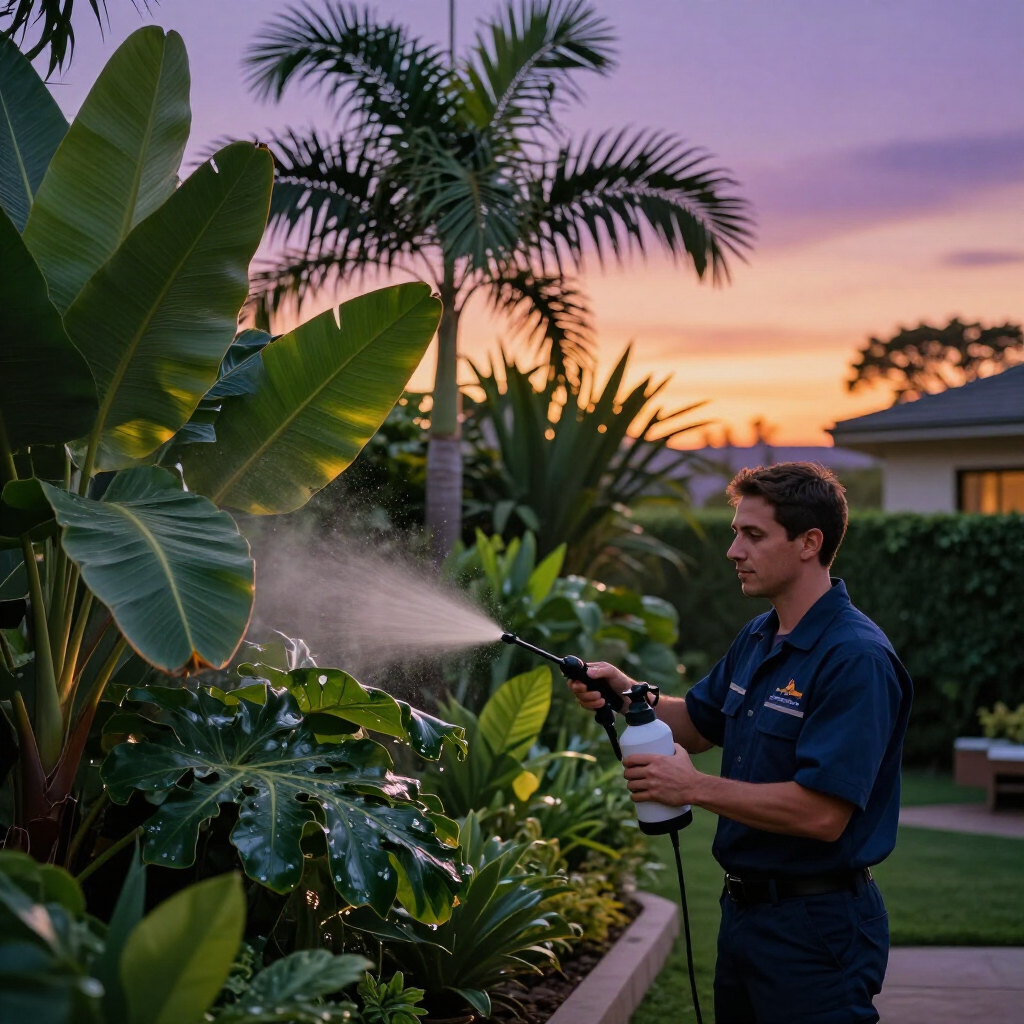
Residual surface treatment. A licensed technician applies a registered insecticide to the places adult mosquitoes rest: the underside of dense foliage, eaves, fences, shaded vegetation. Mosquitoes landing on treated surfaces are killed on contact. It won't eliminate breeding sites, but it knocks the adult population down around your property for 4 to 8 weeks.
Larviciding. For standing water you can't drain (drainage channels, ponds, large water features), a larval insecticide stops the next generation mid-development.
Fogging. Ultra-low volume fogging with a pyrethroid gives rapid knockdown of adults. Best deployed immediately before an outdoor event; the effect lasts 24 to 72 hours.
Treatment Type
Residual surface spray
Larviciding
Best For
Ongoing residential protection
Drains, ponds, unmovable water
Residual Effect
4–8 weeks
Until water drains
Approx. Cost
Included in general pest treatment (~$190–$450)
Why Kirwan and Mundingburra Are Especially High-Risk
Suburbs With the Highest Mosquito Pressure in Townsville
No suburb is mosquito-free, but these cop more than their share:
• Garbutt and Aitkenvale: drainage channels and low-lying ground that pools after rain
• Rosslea and Railway Estate: the Ross River corridor and tidal flats
• Pallarenda and North Shore: mangrove edges create vast Aedes vigilax habitat
• Mundingburra and West End: creek lines and older, shaded, moisture-retaining landscaping
If you live in any of these and the weekly backyard check hasn't fixed the biting pressure, a professional inspection will find the micro-breeding sites you can't see from the verandah.
📞 Mosquito control by JJM Pest Management, Townsville. Residual spray, larviciding and pre-event fogging across all suburbs. Same-day quotes, QLD Health licensed technicians. Visit townsvillepestcontrol.com.au or get in touch to discuss your property.